

Our AI-first automation and workflow orchestration solutions help enterprises and government organizations streamline complex business and IT processes. By combining machine learning, intelligent decisioning, and predictive analytics, we enable workflows that are self-optimizing, resilient, and outcome-driven—reducing manual effort while accelerating operational efficiency.
Key Impact:
- Automate repetitive and rule-based processes at scale
- Trigger intelligent actions using real-time data and insights
- Reduce errors, improve throughput, and enhance service reliability
Advanced topics
A framework where two neural networks, a generator and a discriminator, are trained simultaneously. The generator tries to create data that looks real, while the discriminator tries to distinguish between real and fake data. When a model performs well on training data but poorly on unseen data. Techniques like regularization, dropout, and cross-validation are used to mitigate this. Neural networks have many hyperparameters, like the number of layers, the number of neurons in each layer, the learning rate, etc.
Summary:Neural networks are powerful tools that can model complex patterns in data. They have a wide range of applications, from image recognition to game playing. The field is constantly evolving, with new architectures and techniques being developed to improve performance and efficiency. When a model performs well on training data but poorly on unseen data. Techniques like regularization, dropout, and cross-validation are used to mitigate this. Neural networks have many hyperparameters, like the number of layers, the number of neurons in each layer, the learning rate, etc. Tuning these hyperparameters is crucial for achieving good performance. Training deep neural networks can be computationally expensive, often requiring GPUs.
IT & Business Workflow Automation
Driving Efficiency, Agility, and Measurable Business Outcomes
Security Assessment
Organizations today operate in an environment of increasing complexity, rising operational costs, and growing expectations for speed and quality. Manual processes, fragmented tools, and siloed teams often lead to inefficiencies, delays, and errors.
IT & Business Workflow Automation enables organizations to streamline operations, reduce manual effort, improve accuracy, and align technology with business outcomes. This whitepaper explores how workflow automation across IT and business functions helps organizations achieve operational excellence, scalability, and improved stakeholder experience.
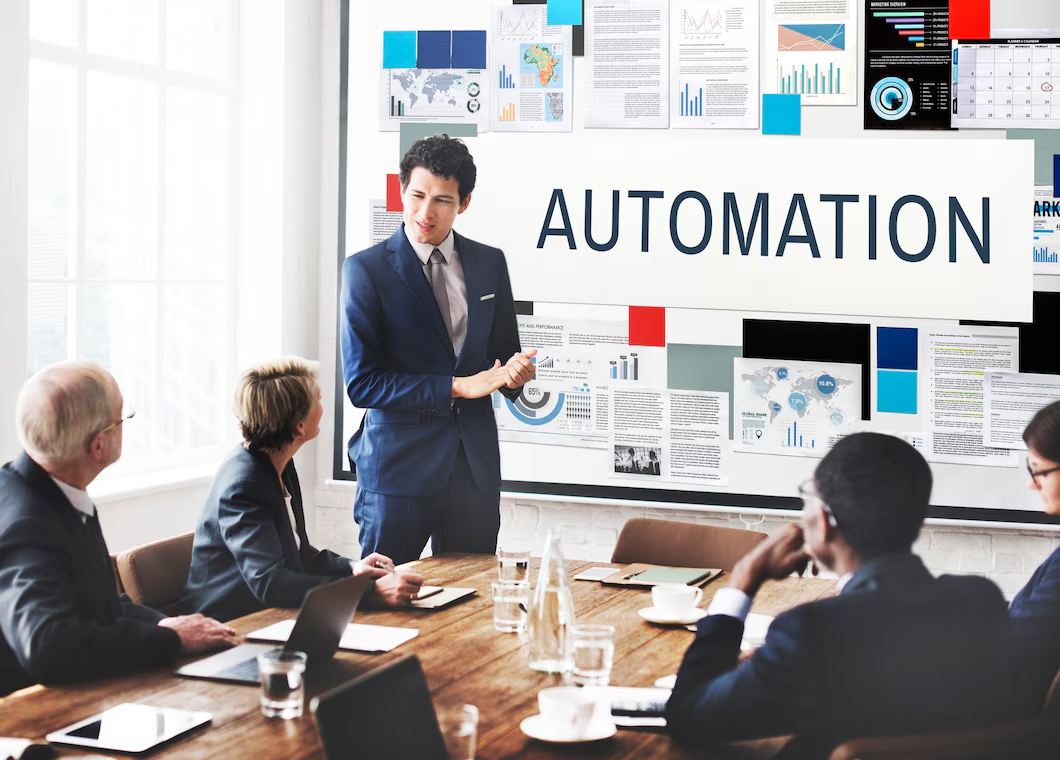
The Need for Workflow Automation
Modern enterprises face several operational challenges:
- Manual, repetitive tasks consuming valuable time
- Disconnected systems and data silos
- Slow service delivery and approval cycles
- High dependency on individuals rather than processes
- Limited visibility into process performance
Workflow automation addresses these challenges by digitizing, orchestrating, and optimizing end-to-end processes.

What Is IT & Business Workflow Automation?
Workflow automation is the use of technology to design, execute, monitor, and optimize processes with minimal human intervention.
It applies across both IT and business domains:
- IT workflows: Service requests, incident resolution, change management, asset lifecycle
- Business workflows: HR onboarding, finance approvals, procurement, compliance, customer operations
Automation replaces manual handoffs with intelligent workflows, rules, and integrations.
Key Components of Workflow Automation
Process Digitization
- Mapping and standardizing manual processes
- Eliminating paper-based and email-driven workflows
- Creating structured, repeatable process flows
Orchestration & Integration
- Connecting multiple systems and applications
- Automating cross-functional handoffs
- Enabling end-to-end process visibility
Rules & Decision Automation
- Automating approvals and validations
- Applying business rules and policies
- Reducing dependency on manual decisions
Monitoring & Optimization
- Real-time process tracking
- Bottleneck identification
- Continuous improvement through metrics


Ensuring Reliability, Control, and Business Continuity Across Enterprise Operations
Executive Summary
Modern enterprises depend on thousands of background jobs, batch processes, integrations, and data pipelines to keep business operations running. From financial reconciliations and payroll to data synchronization, reporting, and system integrations, these jobs form the invisible backbone of digital operations.
Job Scheduling & Orchestration provides centralized control, visibility, and automation for executing and managing these workloads reliably and at scale. This whitepaper explains the importance of job scheduling and orchestration, how it differs from traditional scheduling, and how organizations can use it to improve operational resilience, efficiency, and business
continuity.
The Growing Complexity of Enterprise Workloads
Organizations today operate in environments characterized by:
- Hybrid IT landscapes (on-prem, cloud, SaaS)
- Interdependent batch jobs and workflows
- Time-critical business processes
- Increasing data volumes and integrations
- Limited visibility into job failures and dependencies
Activation Function:The weighted sum is then passed through an activation function, which introduces non-linearity into the network. Common activation functions include:
Traditional, server-based schedulers and scripts are no longer sufficient to manage this complexity.
Sigmoid:Maps input to a value between 0 and 1.
ReLU (Rectified Linear Unit): Outputs the input directly if it’s positive; otherwise, it outputs zero.
Tanh:Maps input to a value between -1 and 1.
Loss Function:This function measures the difference between the network’s output and the actual target. Common loss functions include Mean Squared Error (for regression tasks) and Cross-Entropy Loss (for classification tasks). This is the method used to update the weights. The network calculates the gradient of the loss function with respect to each weight and adjusts the weights in the opposite direction of the gradient (this is known as gradient descent).
A framework where two neural networks, a generator and a discriminator, are trained simultaneously. The generator tries to create data that looks real, while the discriminator tries to distinguish between real and fake data. When a model performs well on training data but poorly on unseen data. Techniques like regularization, dropout, and cross-validation are used to mitigate this. Neural networks have many hyperparameters, like the number of layers, the number of neurons in each layer, the learning rate, etc. Tuning these hyperparameters is crucial for achieving good performance.
The Growing Complexity of Enterprise Workloads
Organizations today operate in environments characterized by:
- Hybrid IT landscapes (on-prem, cloud, SaaS)
- Interdependent batch jobs and workflows
- Time-critical business processes
- Increasing data volumes and integrations
- Limited visibility into job failures and dependencies
Traditional, server-based schedulers and scripts are no longer sufficient to manage this complexity.
What Is Job Scheduling & Orchestration?
Job Scheduling
Job scheduling focuses on when and where a task runs. It ensures that jobs execute at the right time, on the right system, with the required resources.
Typical Capabilities:
- Time-based and event-based scheduling
- Resource and calendar awareness
- Job execution control
- Basic monitoring and alerting
Job Orchestration
Orchestration goes beyond scheduling to manage dependencies, workflows, and end-to-end process execution across systems and platforms.
Typical Capabilities:
- Cross-system workflow coordination
- Dependency and trigger management
- Conditional logic and error handling
- End-to-end visibility and recovery
Together, scheduling and orchestration ensure that complex business processes run reliably, predictably, and transparently.
Why Job Scheduling & Orchestration Matters
Orchestration goes beyond scheduling to manage dependencies, workflows, and end-to-end process execution across systems and platforms.
Without a centralized orchestration approach, organizations face:
- Missed or delayed critical jobs
- Manual intervention during failures
- Lack of visibility into job dependencies
- Higher operational risk and downtime
- Difficulty meeting SLAs and business timelines
Modern orchestration addresses these challenges by enabling proactive control and automation.


Common Use Cases
Cloud Security Posture Management (CSPM)
CSPM focuses on continuous assessment and management of cloud security configurations across IaaS, PaaS, and SaaS environments.
IT Operations
- Nightly batch processing
- Backup and maintenance jobs
- System integration workflows
- Infrastructure and application operations
Data & Analytics
- Data ingestion and transformation
- ETL and data pipeline orchestration
- Reporting and analytics refresh cycles
Business Operations
- Financial close and reconciliation
- Payroll and billing cycles
- Order processing and fulfillment
- Regulatory and compliance reporting
Key Capabilities of Modern Orchestration Platforms
- Centralized job control and monitoring
- Dependency and workflow management
- Event-driven and API-based triggers
- Automated failure handling and retries
- SLA tracking and notifications
Integration Across Hybrid Environments
Orchestrating Workloads Seamlessly Across On-Prem, Cloud, and SaaS
Executive Summary
Modern enterprises operate in hybrid environments that span on-premise infrastructure, private and public clouds, container platforms, and SaaS applications. Business-critical processes rarely reside in a single system; instead, they depend on tightly coordinated integrations and workflows across multiple platforms.
Integration across hybrid environments focuses on orchestrating jobs, data flows, and business processes end-to-end, ensuring reliability, visibility, and control regardless of where workloads run. This whitepaper explores the challenges of hybrid integration and outlines a structured approach to achieving seamless orchestration without platform lock-in.

The Reality of Hybrid Environments
Most organizations today manage:
- Legacy on-premise applications and batch workloads
- Cloud-native applications and services
- SaaS platforms supporting business functions
- Data platforms spread across multiple environments
Key challenges include:
- Disconnected scheduling and automation tools
- Limited visibility across environments
- Complex job dependencies spanning platforms
- Manual coordination during failures
- Difficulty meeting business SLAs end-to-end
Hybrid integration requires a unified orchestration layer rather than isolated automation.
What Does Integration Across Hybrid Environments Mean?
Hybrid integration is the ability to design, schedule, orchestrate, and monitor workflows that span:
- On-premise systems
- Public and private cloud platforms
- Containerized and microservices environments
- SaaS and third-party applications
The goal is not just connectivity, but end-to-end process control, ensuring that dependent tasks execute in the correct sequence with full visibility and governance.
Core Capabilities Required
Unified Orchestration
- Centralized control plane for hybrid workloads
- Dependency management across platforms
- Time-based and event-driven execution
Platform-Agnostic Integration
- Support for heterogeneous technologies
- API-driven and event-based integrations
- Decoupling orchestration from underlying infrastructure
End-to-End Visibility
- Single view of workflow execution
- Real-time status and SLA tracking
- Impact analysis across dependent systems
Resilience & Recovery
- Automated retries and exception handling
- Conditional workflows for failure scenarios
- Graceful recovery without manual intervention

Challenges Without Unified Integration
Organizations lacking hybrid orchestration often experience:
- Fragmented scheduling tools per environment
- Increased operational risk due to manual handoffs
- Delayed issue detection and resolution
- Inconsistent execution of critical processes
- Difficulty scaling operations during growth or cloud migration
These challenges directly impact busine